Overview

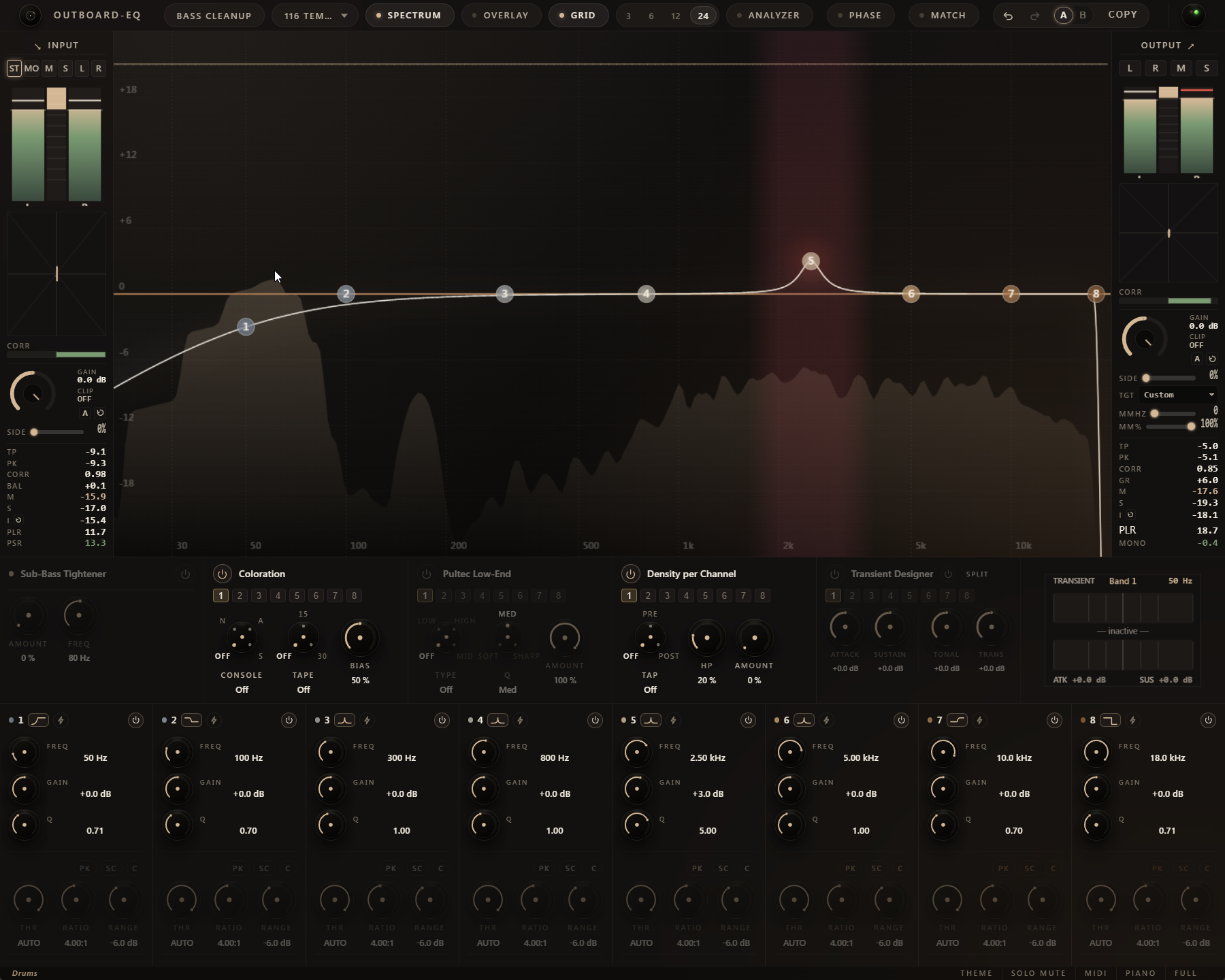
Outboard-EQ takes the modern mastering EQ to the next level — per-band dynamic detectors, Soothe-style spectral suppression, linear and hybrid phase, eight independent hardware character chains, and native Dolby Atmos 9.1.6 support. One plugin replaces a stack: surgical when the cut has to be precise, musical when the track asks for color.

Outboard-EQ plugin interface running in a DAW
Hit Record AUTO, in one click

01/Outboard-EQ

Hit Record AUTO, in one click

Play your source until the HIT pill in the footer fills, pick Master, Mix or Instrument, and press Apply. Outboard-EQ reads crest, brightness and low end and — through the same allocator as EQ Match — writes only the bands your sound needs to move toward the spectral balance of commercial records. One shot, fully undoable, and gentle on already-mastered material. Beta, with a step-by-step guide in Help.
Dynamic EQ with four detectors

02/Outboard-EQ

Dynamic EQ with four detectors

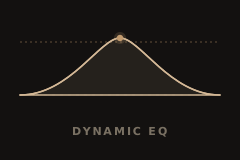
Each of the eight bands has its own sidechain detector with Threshold, Ratio, Attack, Release, and signed Range. Pick Peak for surgical de-essing, RMS for musical glue, Adaptive for a bipolar, program-dependent envelope, or Spectral. An optional free sidechain detector decouples the trigger band from the EQ band — making every cut or boost dynamic without a separate plugin in the chain.

Spectral Dynamics, per band

03/Outboard-EQ

Spectral Dynamics, per band

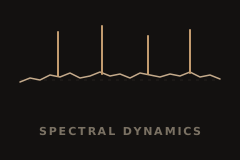
When needed, each band runs through a shared STFT engine (4096-FFT, 75 % overlap) and suppresses resonances bin by bin. Selectivity, Ratio, Knee, Density, and Mask are free per band. A single instance of Outboard-EQ replaces de-esser, resonance hunter, and dynamic EQ in one step — at only 4096 samples of latency, and only active when it has to be.

Linear and hybrid phase, atomically swapped

04/Outboard-EQ

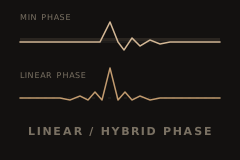
Linear and hybrid phase, atomically swapped

Five phase modes: MinPhase (0 ms latency, default), Natural, LinPhase (frequency-sampling FIR with Kaiser window), Hybrid (LR4 split — lows minimum-phase, highs linear-phase) and PerBand. Three resolution tiers. An atomic IR double-buffer swaps coefficients seamlessly the moment the worker-thread IR is ready. Mastering keeps transient integrity. Mixing stays latency-free.

Per-band hardware character

05/Outboard-EQ

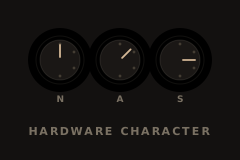
Per-band hardware character

Eight bands, each with its own character chain: Op-Amp emulations (Neve · API · SSL), Tape (15 / 30 ips with bias knob), Pultec low-end (the classic EQP-1A / MEQ-5 boost-cut trick), Density waveshaper (pre- or post-EQ tap), Transient Designer (frequency-selective — eight independent units in one plugin), and SplitEQ-style Tonal/Transient gain. Color where it should sit — at the band, not on the bus.

EQ Match with four reference curves

06/Outboard-EQ

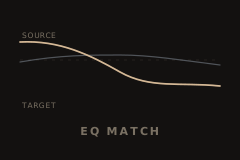
EQ Match with four reference curves

16k-FFT Welch-averaged source PSD over 10 seconds. Capture, pick a target — Pink Noise, Bach Orchestral, Hip-Hop, or Modern Pop — apply, and a greedy allocator writes the result into up to eight EQ bands. Amount, Resolution, and Smoothing as three knobs. No second plugin, no reverse-engineering.

Dolby Atmos up to 9.1.6

07/Outboard-EQ

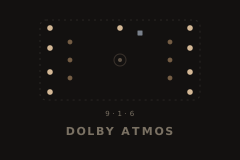
Dolby Atmos up to 9.1.6

Mono, Stereo, 5.1, 7.1, 7.1.4, 9.1.4 and 9.1.6 are natively supported — including a per-band channel mask (16-bit integer per band) so individual bands can target specific channels. The Atmos layout badge in the header signals the active format. Stereo and M/S paths remain untouched.

Further features

And everything else mastering asks for.

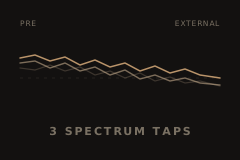
  • Three spectrum taps

    08

    Three spectrum taps

    Pre, Post, and External in a single engine. Worker-thread FFT, triple-buffer publish, tilt 0–6 dB/oct, smoothing from 1/3 to 1/48 octave, five peak-hold modes. A 32-slot cross-instance broker overlays another Outboard-EQ's post-spectrum as an external reference.

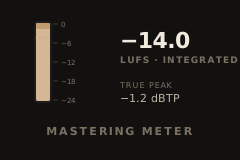
  • Full-spec mastering meter

    09

    Full-spec mastering meter

    4× polyphase oversampled True-Peak (BS.1770, ±0.05 dB). Integrated LUFS meter with nine streaming targets — Spotify, Apple Music, YouTube, Vinyl, CD, Club, EBU R128, ATSC A/85 — K-weighted equal-loud bypass (pre vs. post within ±0.5 dB), and Bob Katz K-12 / K-14 / K-20 reference scales.

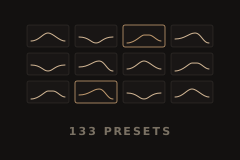
  • 133 factory presets

    10

    133 factory presets

    Sorted across Instrument, Mixing, Mastering, and Character categories — straight from the header picker, with a user library and a dedicated default slot.

Specifications

Runs everywhere your session does.

macOSIn preparation

OS
macOS 10.15+
Architecture
Intel / Apple Silicon
Formats
VST3 + AU + CLAP
RAM
4 GB

Windows

OS
Windows 10 (build 17134) / 11
Architecture
Intel / AMD x64
Formats
VST3 + CLAP (64-bit)
RAM
4 GB

CLAP supported on every platform.

Validated with pluginval at strictness level 10.

FAQ

Questions, answered.

What is Outboard-EQ?

Outboard-EQ is an 8-band mastering equalizer for Windows that combines dynamic EQ, Soothe-style spectral resonance suppression, five phase modes, per-band hardware character, EQ Match, and full true-peak/LUFS metering in a single plugin. It runs as VST3 and CLAP and is built for mixing, mastering, and adding analog character without a chain of separate tools.

Is Outboard-EQ a FabFilter Pro-Q 4 alternative?

Yes. Outboard-EQ covers the surgical and dynamic EQ workflow people buy Pro-Q 4 for, and adds spectral resonance suppression (Soothe-style), per-band hardware character (Neve/API/SSL, tape, Pultec), EQ Match, and native Dolby Atmos up to 9.1.6 — for a one-time €65 instead of $199. See the full comparison on our vs FabFilter Pro-Q 4 page.

Which formats and operating systems are supported?

Outboard-EQ ships today for Windows 10 (build 17134) and Windows 11 as a 64-bit VST3 and CLAP plugin. A macOS build (VST3, AU, CLAP, Intel and Apple Silicon) is in preparation.

Does Outboard-EQ do dynamic EQ and de-essing?

Yes. Every one of the eight bands has its own dynamic EQ with four detector modes — Peak, RMS, Adaptive, and Spectral — plus an optional free sidechain that decouples the trigger from the EQ band. Spectral mode runs a shared STFT engine for Soothe-style, per-bin de-essing and resonance suppression.

What phase modes does it offer?

Five: Minimum phase (zero latency), Natural, Linear phase (Kaiser-window FIR), Hybrid (LR4 split — minimum-phase lows, linear-phase highs), and Per-band. An atomic IR double-buffer swaps coefficients without dropouts, so you can switch modes while audio is playing.

Does it support surround and Dolby Atmos?

Yes. Outboard-EQ natively supports Mono, Stereo, 5.1, 7.1, 7.1.4, 9.1.4, and 9.1.6, with a per-band channel mask so individual bands can target specific channels — making it usable as a multichannel mastering EQ.

How much does it cost — is there a subscription?

Outboard-EQ is a one-time purchase of €65. There is no subscription. The license activates on up to three devices at once, and you can release a device anytime from your account dashboard.

Is there a free trial?

Yes — a free 14-day trial. The complete plugin runs fully for 14 days; download it, use it on your own sessions, and only buy if it earns its place. When the trial ends the plugin keeps loading but its output mutes periodically until you enter a key. Your EU 14-day right of withdrawal still applies after purchase.

Ready when you are

Get Outboard-EQ.

One plugin. Mastering, mixing, character. Try it free for 14 days.

  • Secure checkout
  • Instant download
  • 14-day free trial
  • Free updates
  • pluginval validated
  • Visa
  • Mastercard
  • American Express
  • PayPal
  • Apple Pay
  • Google Pay

Secure payment, handled by Lemon Squeezy