Verb: Liquid engine
The second reverb character — Flow, Shimmer and Tide, and how they change the way a space behaves over time.
LIQUID swaps the classic tank for a different kind of space: one that drifts rather than standing still. Everything you already know still applies — Space, Decay Rate, Brightness, Width, Mix and both EQs work the same — but three extra controls appear in the rack, and the tail stops being a fixed room.
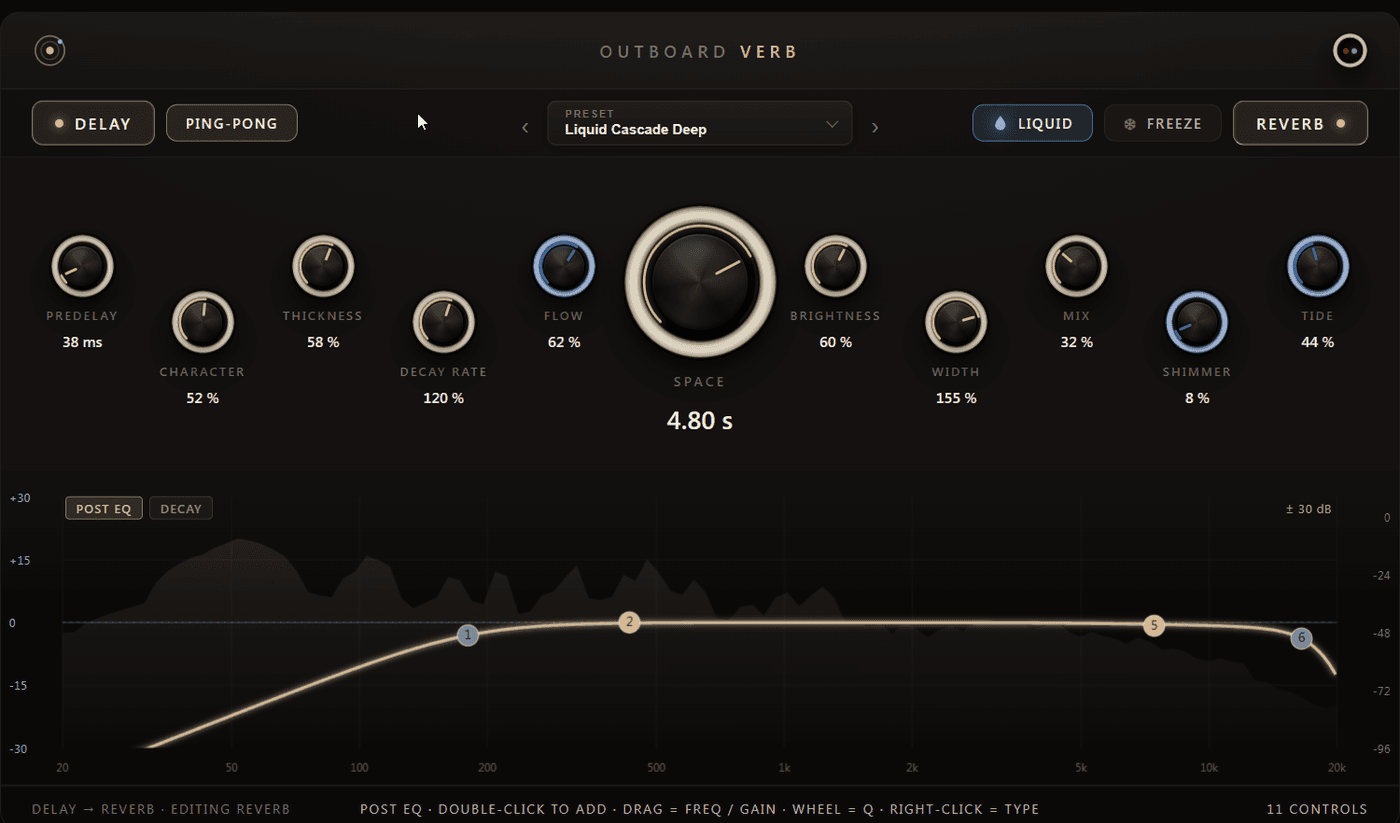
The three Liquid controls are marked in blue so you can see at a glance which part of the rack belongs to the engine and which is the shared reverb.
Flow
0 – 100 %. How much the space moves. At low values the difference from the classic tank is subtle, more a loosening than an effect. Push it up and the tail develops a slow internal drift that keeps long decays from ever sounding frozen or metallic.
This is the control that decides whether Liquid reads as "a nicer room" or as an effect in its own right.
Shimmer
0 – 100 %. Lifts a harmonic sheen above the tail — content that was not in the source, sitting an octave up and decaying with the room.
A little goes a long way. Around 5–15 % adds sparkle to a pad without anyone noticing why; past 40 % it becomes the point of the sound.
Tide
0 – 100 %. Swells the whole tail slowly in and out, over seconds rather than milliseconds. It is the difference between a static wash and something that breathes underneath the track.
Tide is deliberately slow. If you are looking for audible modulation, that is Character or Flow — Tide operates below the rate at which you would call it vibrato.
When to reach for it
- Pads and sustained material — Liquid keeps long tails alive where a static room would turn into a wall.
- Sparse arrangements — the movement fills space without adding level.
- Anything that felt "too digital" — Flow at 40–60 % usually fixes it.
Conversely, for a drum room or a short plate that has to sit still, the classic tank is the better choice. Liquid is a character, not an upgrade.
Verb: The two EQs
Post EQ shapes the tone of the wet signal; Decay EQ shapes how long the tail rings per frequency. Same layout, completely different job.
Verb: Presets & licence
The preset browser, favourites and the default slot — plus activation, the 14-day trial and moving your licence to another computer.