Verb: Reverb
Space, Predelay, Character, Thickness, Decay Rate, Brightness, Width, Mix and Freeze — what each reverb control does and which ones interact.
The reverb is a true-stereo network: left and right run through two independent structures rather than one mono tail spread apart. That is what keeps a wide setting from collapsing when someone checks the mix in mono, and why the image stays open even on long decays.
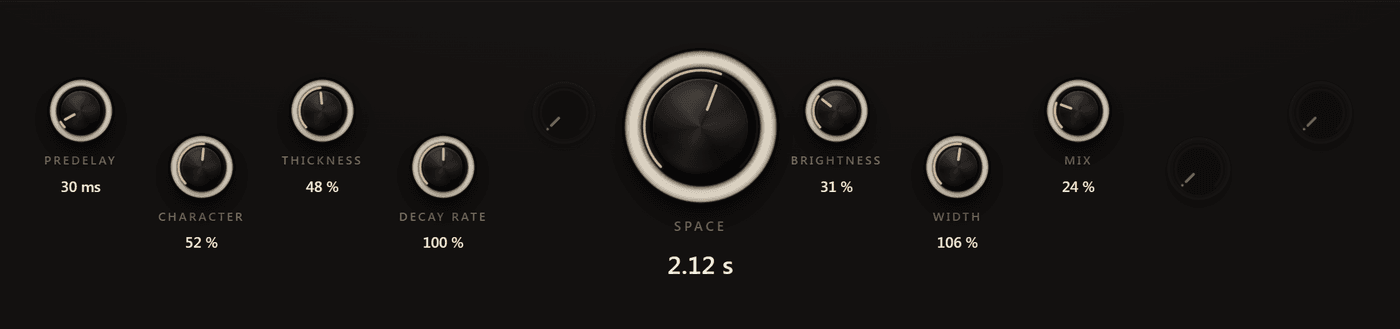
Space
0.1 – 20 s. The centre knob, and the one that defines the sound. It sets the size of the room and, with it, the base decay time — from a tight ambience that just glues a source in place, up to a cathedral you can play chords into.
Space and Decay Rate work together: Space sets the room, Decay Rate scales how long that room rings.
Predelay
0 – 500 ms. The gap between the dry hit and the start of the tail. This is the control that keeps a vocal or a snare in front of the space instead of being swallowed by it — even a short 20–40 ms is usually enough to hear the source clearly again without making the reverb any quieter.
Decay Rate
25 – 400 %. Scales the decay time set by Space. At 100 % you hear the room as its size implies; below that it dries out, above it rings on. Use it when the size is right but the length is not.
For decay that differs per frequency, use the Decay EQ — see Verb: The two EQs.
Character
0 – 100 %. How much movement lives inside the tail. Low values give a still, even decay; higher values introduce slow modulation that keeps the tail from sounding static or metallic, especially on long settings.
Thickness
0 – 100 %. The density of the tail's low end — how much body and sustain sits underneath. Raising it damps the low frequencies less, so the room feels heavier.
Brightness
0 – 100 %. The same idea at the other end: how much high frequency survives into the tail. Lower it for a darker, more distant room; raise it for air.
Width
0 – 200 %. The stereo spread of the tail. 100 % is the network's natural width; below that it narrows toward the centre, above it widens beyond the speakers. Because the two sides are genuinely independent, this stays stable in mono rather than cancelling.
Mix
0 – 100 %. The balance between dry and wet. On a channel insert, values between 15 % and 35 % are typical; on a send bus you will usually want 100 %.
Freeze
Catches the tail as it is and sustains it indefinitely. Play a chord, freeze the bed it leaves, and keep playing over the top — everything else stays live, so you can still shape the frozen bed with the EQs while the dry signal carries on. Switching Freeze off lets the held tail decay normally from where it was.
Verb: Interface & modes
The Outboard-Verb window: the mode row, the preset bar, the knob rack and the display underneath — and how Delay, Reverb and Combined relate to each other.
Verb: Delay
Time, Feedback, Ping-Pong, Crossfeed, Offset, FB Tone, Width and the low and high cut — the delay section and how it feeds the reverb.