Verb: Delay
Time, Feedback, Ping-Pong, Crossfeed, Offset, FB Tone, Width and the low and high cut — the delay section and how it feeds the reverb.
The delay is a stereo delay with two taps that can be offset against each other, sent alternating left and right, and bled back into one another. In Combined mode it feeds the reverb, so the repeats bloom into the room instead of sitting in front of it.
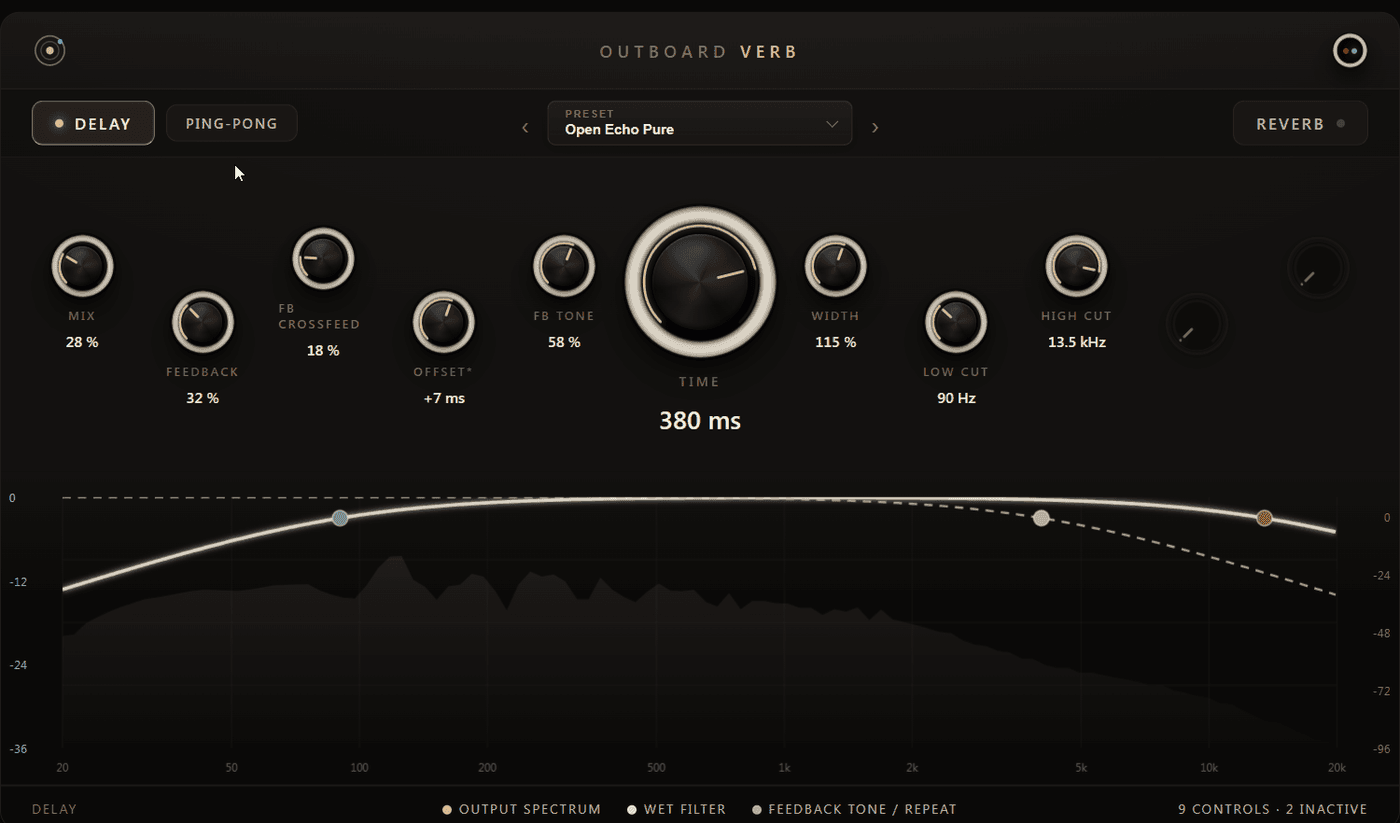
Time
1 – 2000 ms. The centre knob: the base delay time. Both taps derive from it, shifted by Offset.
Offset
−50 – +50 ms. Shifts one tap against the other, which is what turns a plain stereo delay into something that feels wide and alive.
Below a base time of about 26 ms the offset is automatically reduced so both taps stay positive and centred — otherwise a short delay with a large offset would try to place one tap before the input.
Feedback
0 – 95 %. How much of the output is fed back in. The ceiling is deliberately below 100 %, so the delay always decays instead of building up without limit.
Ping-Pong
Alternates the repeats between left and right instead of keeping each tap on its own side. On its own it can feel mechanical; combined with Crossfeed it turns into a wide, natural bounce.
FB Crossfeed
0 – 100 %. How much each side bleeds into the other on every repetition. At 0 % the two sides are independent; raise it and the repeats gradually merge toward the centre as they decay.
FB Tone
0 – 100 %. Darkens each successive repeat. Low values make the delay fade into the background quickly, the way a tape or analogue delay does; at 100 % the repeats keep their brightness.
Width
0 – 200 %. The stereo spread of the repeats, independent of the reverb's own width control.
Low Cut and High Cut
20 – 2000 Hz and 800 Hz – 20 kHz. Filters inside the feedback loop, so their effect accumulates with every repeat rather than being applied once.
This is the fastest way to keep a delay out of the way of the source: pull the low cut up to around 200–300 Hz and the repeats stop competing with the body of the vocal, without touching the dry signal at all.
Verb: Reverb
Space, Predelay, Character, Thickness, Decay Rate, Brightness, Width, Mix and Freeze — what each reverb control does and which ones interact.
Verb: The two EQs
Post EQ shapes the tone of the wet signal; Decay EQ shapes how long the tail rings per frequency. Same layout, completely different job.